The main guide
How to Peptide: a calm beginner's guide
What peptides are, which ones women use for weight, metabolism, energy and skin, how to judge a seller by its COA, and what to learn before a first course.
If you're here, you probably know the feeling: the scale creeping up while you eat less than ever, the afternoon wall, the 3 a.m. wake-ups, skin that suddenly looks thinner. I've been there, and in some ways I still am. You're not alone in it either. Thousands of women are dealing with exactly the same thing right now, and many of us were simply told it's "just age."
That's why this guide exists. Across the US, more and more women have found real help, and for many of them peptides are part of it. But peptides are also everywhere now: on a friend's fridge, in your feed, in the serum on your bathroom shelf. Some of what you hear is careful and true, and some of it is a sales pitch dressed up as science. This guide covers what peptides are, what they can and can't do, how to buy sensibly, and what to learn before you try one, so you can make up your own mind.
What a peptide actually is
A peptide is a short chain of amino acids, the same building blocks that make up protein. Think of protein as a long sentence and a peptide as a short phrase. Because they're short, many peptides act like messages: they tell a cell to release a hormone, make more collagen, or slow down how fast your stomach empties.
Your body already makes thousands of them. Insulin is a peptide. So is GLP-1, the gut hormone behind today's best-known weight-loss medicines. When people say they're "on peptides," they usually mean one of three things:
- Prescription peptide medicines such as semaglutide (Wegovy, Ozempic) and tirzepatide (Zepbound, Mounjaro). These went through large human trials and are approved for specific uses.
- Topical and oral peptides in skincare and supplements, such as copper peptides (GHK-Cu), signal peptides like Matrixyl, and collagen peptides you stir into coffee.
- Research peptides such as BPC-157, CJC-1295 or MOTS-c, sold as powders in vials. Most have promising lab or animal data and very little human data. None of them is approved for you to use.
Those three groups carry very different amounts of evidence, so keep them apart in your head. Most of the confusion online comes from talking about all three as if they were one thing.
What peptides can help with
Here are the four areas these notes cover, and roughly where the evidence stands for each.
Weight & shape
This is where the evidence is strongest by far. In large trials, semaglutide 2.4 mg led to about 15% average weight loss over 68 weeks, and tirzepatide to around 20% at the highest dose over 72 weeks. Newer drugs that act on several hormones at once, such as retatrutide, have shown even larger losses in trials.
The catch matters especially for women, who already lose muscle more easily with age: part of the weight lost on these medicines is muscle, not fat. Protein and strength training aren't optional extras here. They decide what the scale number is made of. Our "Weight & Shape" guide goes into this in detail.
Metabolism
GLP-1 medicines also improve blood sugar and insulin sensitivity, which is often where midlife weight gain really starts. Hormone shifts, cortisol and sleep play a big part too, and no peptide fixes those on its own. See Metabolism.
Daily energy
To be honest, this is the area with the weakest peptide evidence. Many "energy" peptides are sold on lab and animal data alone. Ongoing fatigue more often comes from low iron, thyroid problems, poor sleep or blood sugar swings, and those are worth ruling out first. See Daily Energy.
Skin & renewal
This is the friendliest place to start. Topical peptides such as copper peptides and Matrixyl, and oral collagen peptides, have human studies behind them, a good safety record and nothing to inject. See Skin & Renewal.
The most talked-about peptides, in plain words
A quick orientation, not a shopping list. "Status" means legal and evidence status as we write this. Check current rules where you live.
- Semaglutide. A GLP-1 medicine. Reduces appetite and slows stomach emptying. Status: prescription medicine with strong human evidence.
- Tirzepatide. Acts on GLP-1 and GIP. Usually leads to more weight loss than semaglutide in trials. Status: prescription medicine with strong human evidence.
- Retatrutide. Acts on GLP-1, GIP and glucagon. Showed very large weight loss in trials. Status: investigational and not approved. Anything sold online is not the trial drug.
- Tesamorelin. Prompts your own growth hormone release and reduces belly fat in one specific patient group. Status: prescription medicine for a narrow use.
- CJC-1295 and ipamorelin. Often stacked together to raise growth hormone, mostly for body composition and sleep. Status: not approved, with limited human data.
- BPC-157. Popular for recovery and gut comfort. Status: mostly animal data. In 2023 the FDA flagged it as a possible safety risk in compounded products.
- MOTS-c. Comes from mitochondria and is studied for metabolism and exercise capacity. Status: early research, mostly in animals.
- GHK-Cu (copper peptide). Used on skin for firmness and fine lines. Status: widely used in cosmetics, with modest human studies for topical use.
- Collagen peptides. Taken by mouth for skin hydration and elasticity. Status: a food supplement. Several small trials show modest benefits, but many are industry-funded and the most rigorous ones find smaller effects.
Stacks: why people combine them, and why simple usually wins
A "stack" just means using more than one thing at once for the same goal. You'll see stacks like a GLP-1 plus a growth-hormone peptide "to protect muscle," or BPC-157 plus TB-500 "for recovery."
Every extra compound adds another set of unknowns, and most stacks have never been studied together. When something goes wrong, you can't tell what caused it. The stacks that actually hold up are almost boring:
- For weight: one well-studied medicine, plus protein at every meal and two or three strength sessions a week.
- For skin: a topical peptide serum, a retinoid at night, sunscreen every day, and optionally collagen peptides by mouth.
- For energy: sorting out sleep, iron and blood sugar first, then deciding whether you still need anything else.
Free printable guide
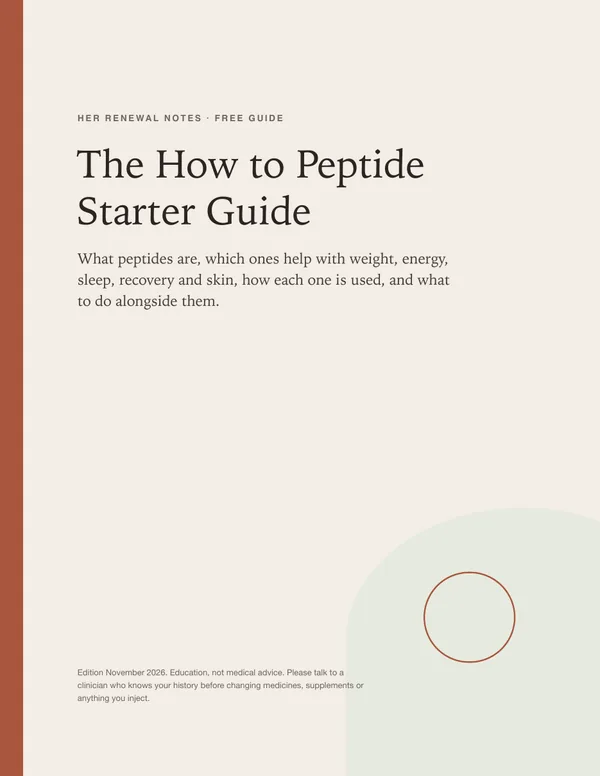
The How to Peptide Starter Guide
Which peptides help with weight, energy, sleep, recovery and skin, how each one is used, and what to do alongside them so they work.
How to buy without getting fooled
If you buy peptides online, the shop is where most of the risk sits. Here's how to judge one.
Read "research use only" literally
Many shops sell peptides labeled "for research use only, not for human consumption." Some sellers treat this as a wink, as though everyone knows what it really means. Don't. The label means exactly what it says: nobody has approved this product for you, and nobody has promised it's safe to inject. It tells you nothing about quality. You're the one making the judgment, so make it with your eyes open.
Check the COA, and check it properly
A COA (certificate of analysis) is a lab report for a batch. A good one shows:
- An independent lab's name, one you can look up, not just the seller's own letterhead.
- A batch or lot number that matches your vial. A COA for some other batch proves nothing about yours.
- A recent test date.
- Purity by HPLC, usually given as a percentage. Look for 98% or higher.
- Identity by mass spectrometry, which confirms the molecule is what the label says.
- Ideally, endotoxin and sterility results. These are often missing, and they matter for anything injected.
If the lab offers a way to verify the report, such as a code or a public lookup page, use it. A shop that won't show you a COA, or only shows one blurry image for every batch, has told you what you need to know.
Other green and red flags
- Green: clear contact details, batch-level COAs, honest descriptions, no miracle promises.
- Red: "lose 10 kg in two weeks" claims, before-and-after photos with no context, prices far below everyone else's, pressure to buy a "full stack."
Before your first course: what to learn
Please don't start a peptide because a friend did. Before anything you inject, learn these basics, ideally with a clinician.
- Know why you're doing it. Pick one goal with a number you can measure, such as waist size, fasting glucose or how you feel at 3 p.m. You can't judge whether something works if you never decided what "working" means.
- Get baseline bloodwork. A metabolic panel, HbA1c, lipids, thyroid, iron/ferritin and vitamin D give you a starting line and might reveal that the real problem is something else.
- Ask about approved options first. For weight and blood sugar, prescription medicines with real human data exist, and a clinician or telehealth service can prescribe them and monitor you.
- Understand the product's form. Many peptides come as freeze-dried powder that has to be mixed, stored cold and used within a set time. Learn this from a pharmacist or clinician before day one, not after.
- Start low and go slow. GLP-1 peptides are started at a low dose and raised over weeks to limit nausea. Don't build your own dosing plan from forums or a seller's chart.
- Keep a log. Write down dose changes, side effects, sleep, appetite and energy. Patterns show up in a log that never show up in memory.
- Know your stop signs. Severe stomach pain, persistent vomiting, signs of an allergic reaction, or anything that scares you means you stop and get medical help.
What results actually look like
Expect slow, ordinary-looking progress. Clothes fit a little looser over a couple of months. Afternoon energy evens out. Skin looks fresher in photos taken weeks apart. That's what it looks like when something is working. Anything promising fast, dramatic change is selling you something.
Frequently asked questions
Are peptides safe for women?
It depends entirely on which peptide. Approved medicines like semaglutide have large safety datasets and known side effects. Topical skincare peptides are generally very low risk. Research peptides have little human safety data, so nobody can honestly tell you they're safe.
Do peptides work without diet and exercise?
Weight-loss medicines reduce appetite, so many people lose weight without a strict diet, but they risk losing muscle as well. Protein and strength training are what keep the result looking and feeling good.
What does a COA prove?
That one batch was tested for identity and purity by the named lab. It's only useful if the lab is independent, the batch number matches your vial and the report can be verified.
What's the best peptide to start with?
For most women, a topical peptide serum or oral collagen peptides. They carry little risk, the evidence is modest but real, and there's nothing to inject. For weight or blood sugar, talk to a clinician about approved medicines.
Is "research use only" just a formality?
No. It means the product isn't approved for human use and comes with no promise of safety. Take it literally.
Where to go next
Pick the area that's bothering you most and start there: Weight & Shape, Metabolism, Daily Energy or Skin & Renewal. Or read Real Journeys to see how these pieces come together in one woman's life.